

24 Apr Why Every Garden Needs A Focal Point
Katie Moyes looks at the why’s and wherefores of building a focal point into your garden design.
Why every garden needs at least one focal point
- Adds oodles of interest
- Makes the space feel more inviting
- A garden with focal points is more restful because your eyes have something to settle on
- Encourages garden visitors to explore more
- Leads the eye away from things you may not want to see – eg an ugly view beyond the fence
- Focal points are a great way to express personal taste and interests
- Can add intrigue by making use of the art of hide and reveal
- Helps create a journey around the garden
Keep reading this article to discover how garden designers use focal points to add the wow factor to a space, a list of ideas for focal points, and suggestions for how you can turn everyday garden objects into stunning features.
Discover why garden designers are so fond of focal points
Focal points make a garden more interesting. As an analogy, think for a moment about how you feel when you find yourself in a room with no focal point. A hospital waiting room for example. Your eyes will wander aimlessly around the space. Until your eyes settle on something of interest, you feel bored and slightly unsettled.
The same thing will happen if your garden is without a focal point. It’s why newbuild gardens are so uninviting. A few paving slabs and an expanse of grass won’t encourage anyone into the great outdoors. Even modern minimalist gardens have something to look at!
A garden can be crammed with plants and features but without a focal point it’s unlikely to be easy on the eye. A patio plastered with pots and ornaments tends to look cluttered rather than interesting. And a large border can dominate the plot without adding value if it is just a cacophony of colour with no apparent focus.
Garden designers use focal points within a garden for several reasons. They are really useful for distraction the eye from things you don’t want to focus on. Things that make you feel uncomfortable such as the neighbour’s windows overlooking your garden or the wheelie bins in the corner.
A series of carefully positioned focal points can entice you into the garden and lead you on a journey.
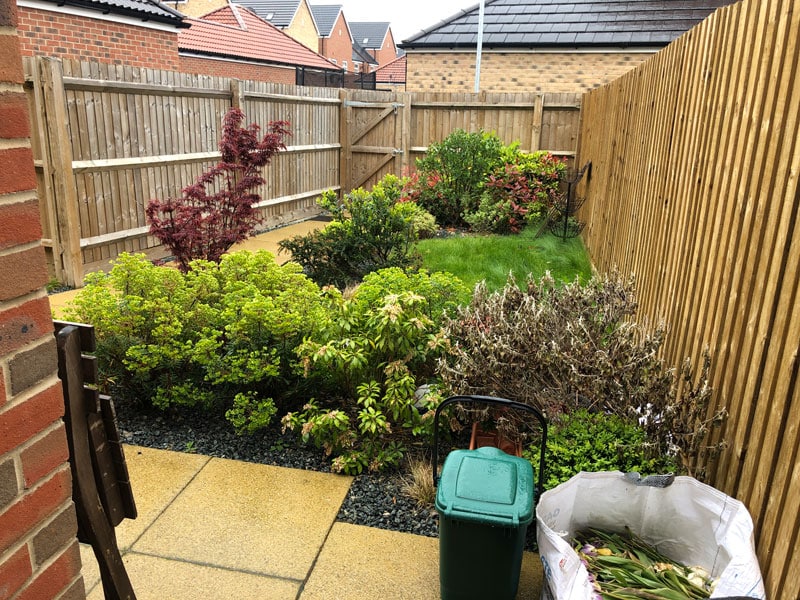
This garden didn’t have a well defined focal point which made it feel somewhat redundant. Scroll down to see how we transformed it.
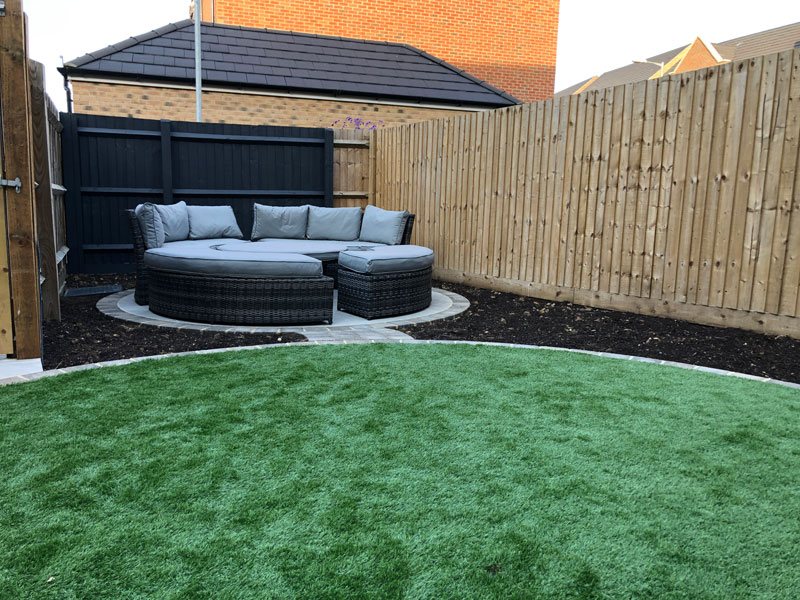
The same garden as in the picture above. We’ve moved the entrance gate and created an intimate seating area. Now it’s a destination with a purpose.
When the soil has been filled with cottage garden planting, this space will be irresistible

A carefully positioned bench makes an incredible focal point. This gardener has dressed the bench with cushions that match the flowers on the climbing plant behind it.
What Makes a Good Focal Point?
Writers use punctuation points and paragraphs to make a piece easier to read. Full stops and commas are a sign that we can take a breath or prepare to receive new information. In a garden, focal points are the equivalent of punctuation marks. They give our eyes something to rest on, and by stopping, even for a millisecond, we allow our brains to process information from around us before moving on. It’s as though the focal point is reducing overwhelm so that we can feel more in control of our thoughts.
A focal point therefore is going to be something that stands out from its surroundings. A green shrub among other green shrubs will not be a focal point. A statue amongst green shrubs will be.
A fence panel in a long line of fence panels will give your eye nothing to focus on, but a strategically placed tree on the fence line – well – you get the idea.
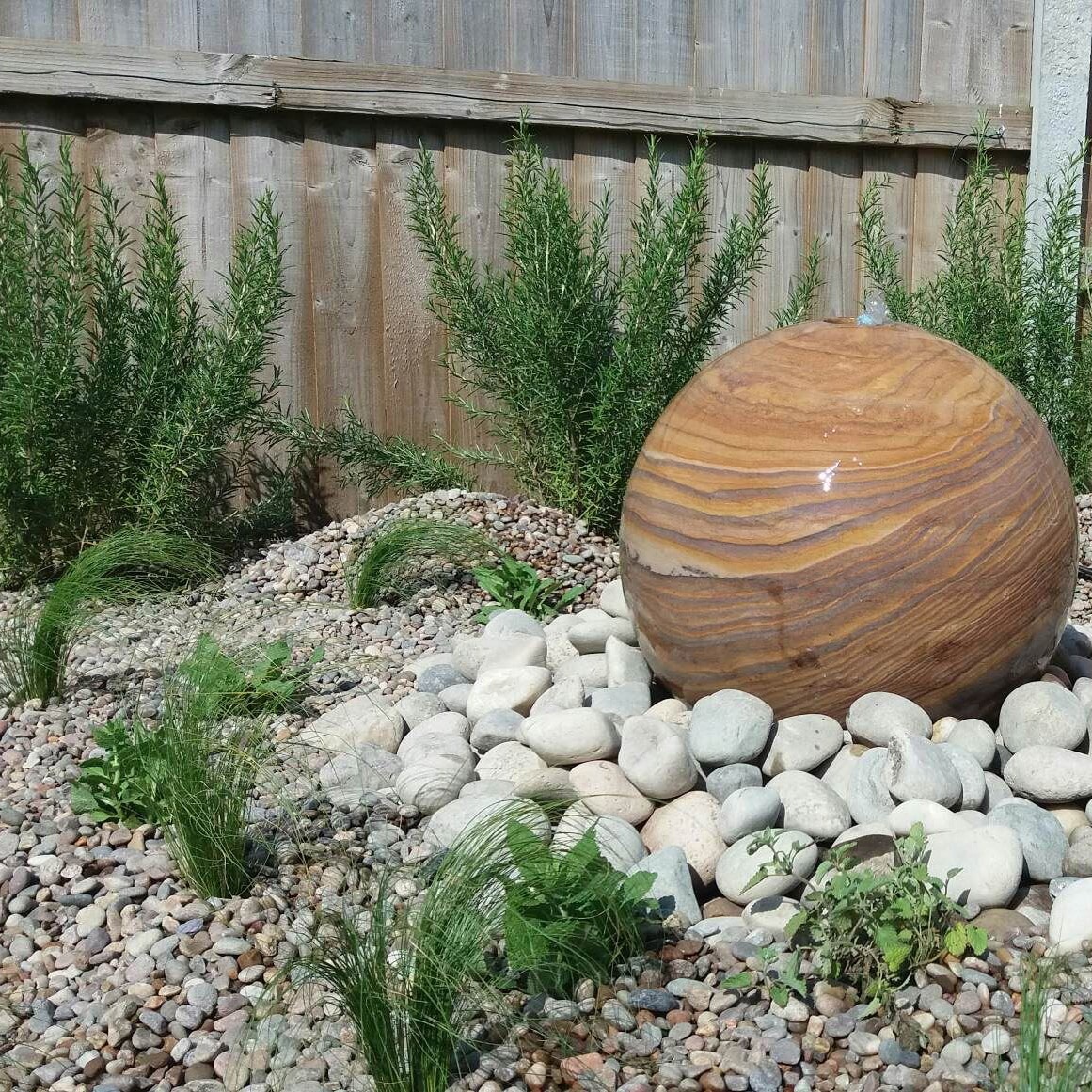
A gently bubbling water feature makes a lovely focal point for a coastal themed garden
Here Are A Few Ideas For Garden Focal Points
- A signature plant
- An outsized or brightly coloured container
- A mosaic feature on a patio
- Garden furniture
- A pretty arbour
- A destination – a summer house or a pergola viewed from a distance
- A beautiful tree lit from beneath
- A piece of art
- Topiary
- Laser cut screens mounted on a fence or wall
- Water feature
- Island bed
- Small patio or deck with hot tub or bistro furniture
- A door in a wall or a gap in a hedge
- Your front door when viewed from a driveway
- Bird feeder
- Children’s play area

A well thought out planting plan can ‘move’ focal points around the garden as the seasons change. The colourful blue flowers on this Ceanothus will eventually fade leaving a beautiful dark green backdrop for the other plants to shine out against
How Many Focal Points Do I Need In My Garden?
Please don’t be tempted to create too many focal points. 1-3 are plenty for a small garden. With a large garden you can get away with more of them. But there’s a fine line between multiple focal points and confusing clutter. Positioning and spacing is key.
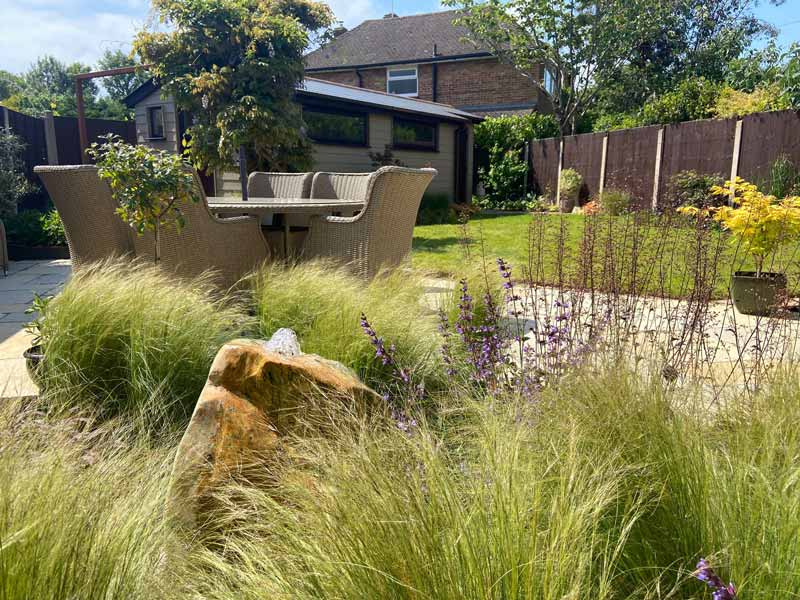
A series of focal points in a row, designed to lead you deeper into the garden. Beyond the fountain is an inviting seating area and beyond that is an intriguing building with wisteria around the door.
Where To Place Your Garden Focal Point
Which parts of the garden are you most likely to look at when you are standing at the kitchen sink, sitting in your living room or opening your bedroom curtains? These are the prime position for your focal features.
Which way do you benches and chairs point in your garden? Place a focal point in your sight line so that you feel more inclined to sit a while longer and relax.
Outdoor lighting creates focal points when the sun has set. Look at how the shapes and textures of the screens and the plants are accentuated by carefully place illuminations.
Can You Turn An Ordinary Garden Feature Into A Focal Point?
Absolutely yes you can turn ordinary garden features into focal points. String some twinkling lights in a tree, paint your garden shed to resemble a beach hut, install a rose arch over a gate or fix a large clock on a boring wall, these are all examples of making best use of what is already in your garden.
Conversely, if you want a feature to ‘disappear’, use focal points to draw your attention away from it.
Focal points are, and always will be, an important part of garden design. More often than not, they will be considered in the early stages of the design stage as views and vistas are all part of the layout. Where will you place yours?
3D garden design can help you to decide where to place your focal points, discover more in our blog.
No Comments